
Matcha: the complete guide to Japanese powdered green tea

By the LBDT Sommelier · published on · updated on · 5 min read
Reviewed and approved by the La Boutique du Thé team
A deep green powder, a delicate froth, the precise gesture of the whisk: matcha is another way of drinking tea, in which the whole leaf is enjoyed in suspension. Official Mariage Frères stockist in Bordeaux and Nice since 1999, our house guides you in understanding it, choosing it and preparing it properly.
What exactly is matcha?
Matcha is a Japanese green tea ground into an extremely fine powder. It comes from a particular tea, tencha, whose tea bushes are shaded for three to four weeks before the harvest. Deprived of direct light, the leaf concentrates its chlorophyll and amino acids: this is what gives matcha its jade colour and the gentle, deep flavour the Japanese call umami.
After picking, the leaves are steamed and then dried, stripped of their stems and veins, and finally ground with a stone mill. The mill turns slowly and produces only a few dozen grams per hour, the condition for a silky powder that does not heat up during grinding. Unlike a steeped tea, matcha is drunk leaf and all: the powder stays in suspension in the water, and you enjoy everything the leaf contains.
Uji and the great terroirs of Japanese matcha
Uji, south of Kyoto, has grown tea since the 13th century and saw the birth of the shading techniques that still define fine matcha today. Its morning mists, its hills and nearly eight centuries of expertise make it the benchmark terroir, the one the whole world associates with the finest matchas. Other regions produce well-crafted matchas, notably Nishio in Aichi Prefecture, Shizuoka and Kagoshima, each with its own style.
It is in Uji and the Kyoto region that Mariage Frères selects its great matchas, which we offer in our Bordeaux and Nice shops as well as online, alongside our green teas from Japan.
Ceremonial, premium or culinary: which matcha should you choose?
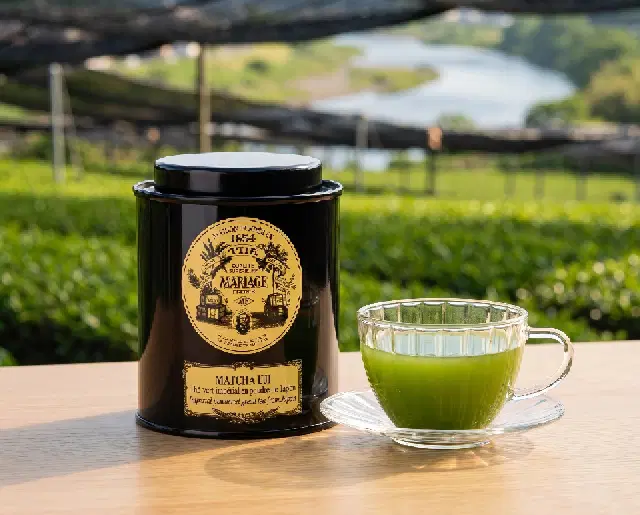
There are three families of matcha. Ceremonial matcha, the matcha of chanoyu, the Japanese tea ceremony, brings together the finest crus: made from the youngest shoots, purer, more elegant and rarer, it is drunk from the bowl, simply whisked in water. At Mariage Frères, the matchas from Uji and Kyoto are fine examples.
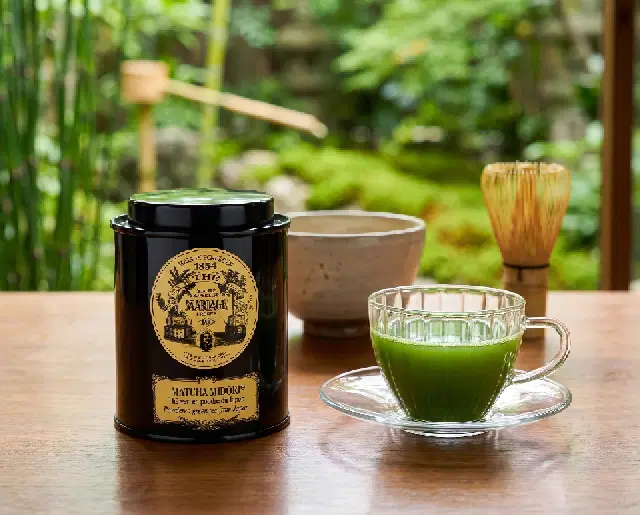
Next come the premium matchas, of very good quality, such as Matcha Midori: less deep in umami than the Grands Crus, but very good and only slightly bitter, they suit traditional preparation just as well as an excellent latte. Baking matchas, also called culinary matchas, come from later harvests: bolder, they stand up to milk, sugar or baking, for lattes and cooking.
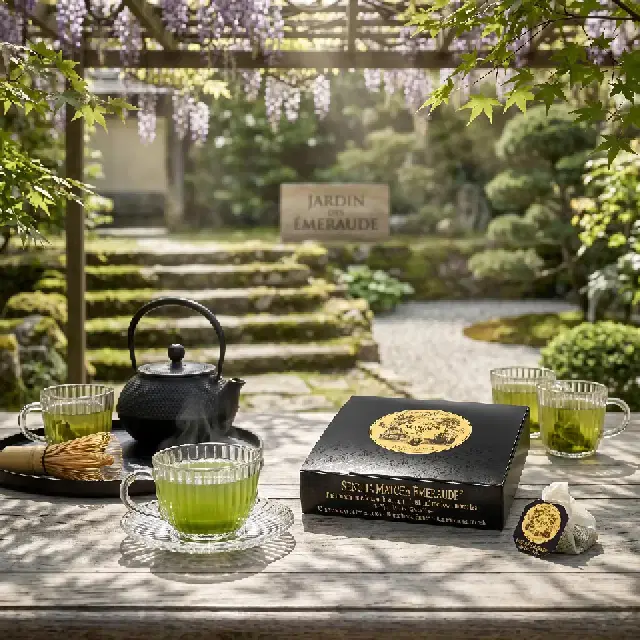
To enjoy matcha without all the preparation in a bowl, try green teas enhanced with matcha, in cotton muslin tea sachets: Sencha Matcha Émeraude (a sencha with matcha) and Genmaicha Matcha Émeraude (green tea, toasted puffed rice and matcha) are steeped like a green tea, at 80 °C for 3 minutes, and offer an everyday cup of great simplicity.
How do you prepare matcha in a bowl?
The classic preparation, usucha or thin tea, calls for little equipment and a great deal of consistency. Sift two grams of matcha directly into a wide bowl, then pour in about 70 ml of water at 80 degrees, between 70 and 80, never boiling: water that is too hot crushes the aromas and hardens the bitterness. Then whisk with the chasen, the finely tined bamboo whisk, in a quick W-shaped motion, with a supple wrist, until a fine, even foam forms on the surface.
Koicha, or thick tea, reserved for ceremonial Grands Crus, calls for twice as much powder, four grams, for just 30 ml of water at 80 degrees: it is kneaded slowly with the chasen, without seeking foam, until a smooth, glossy cream forms.
There is no substitute for the chasen: neither a spoon nor a kitchen whisk aerates the powder in the same way. You will find matcha whisks and bowls among our tea accessories.
Matcha latte, baking: matcha beyond the bowl
For a matcha latte, start with a concentrated matcha: two grams whisked into 30 to 40 ml of water at 80 degrees, then topped up with 100 to 150 ml of hot milk, at around 65 degrees, lightly frothed, or with cold milk over ice in the warmer months. A premium matcha such as Midori works wonders here, and a baking matcha keeps all its presence, whereas a more delicate ceremonial Grand Cru would fade behind the milk.
In baking, the same logic applies. For a loaf cake, financiers or madeleines, allow about six grams of matcha per hundred grams of flour, that is three level teaspoons, sifted with the flour to avoid lumps; for an ice cream or a granita, first dissolve the powder in a little hot water. The green colour is all the better preserved when the baking remains gentle.
How do you recognise a good matcha and keep it?
A good matcha can be seen before it is tasted: the colour should be a vivid, luminous jade green, the powder as fine as talc, with no perceptible grain between the fingers. On the nose, it evokes fresh grass and chestnut. On the palate, umami dominates, carried by a noble bitterness that never grates. A dull or yellowing hue, a grainy texture or an aggressive bitterness signal a modest grade or a powder that has aged.
Matcha dislikes air, light, heat and odours. Keep it in the refrigerator, in its airtight tin tightly closed, and wait a few minutes after taking it out before opening it, to avoid condensation. Once the tin is opened, matcha is ideally enjoyed within four to eight weeks, while its freshness is intact.
The sommelier's selection


Frequently asked questions
What is the difference between matcha and a classic green tea?
A classic green tea is steeped and then strained: you drink a fragrant infusion. Matcha is a whole leaf ground into powder, whisked into water and drunk in suspension. Texture, intensity and the act of preparation are therefore entirely different, even though both come from the same plant, the tea plant.
Can matcha be prepared with boiling water?
No, boiling water burns the powder: bitterness takes over and the sweet notes disappear. Aim for water at around 80 degrees, between 70 and 80: pour the boiling water into a cup to let it cool, or add a little cold water to it, before pouring it over the powder. This is the temperature recommended by the producers of Uji and Kyoto.
How long does matcha keep?
Unopened, matcha keeps for about a year in a cool place. Once opened, its colour and aromas fade quickly on contact with air: ideally use it within four to eight weeks, in an airtight tin kept in the refrigerator, away from strong-smelling foods.
Does matcha contain caffeine?
Yes. Theine and caffeine are one and the same molecule, and matcha provides more of it than a steeped green tea, since the whole leaf is consumed. A cup nevertheless generally contains less than a coffee. It is therefore best enjoyed in the morning or early afternoon.
To go further
More guides from the house
- Matcha whisk and bowl: choosing, using and caring for the chasen and chawanBamboo matcha whisk: how to use it, which matcha bowl to choose and how to care for your chasen so it keeps its shape, with our bowls.Read the guide →
- Matcha set: give it ready-made or build it piece by pieceA matcha set brings together bowl, bamboo whisk, scoop and sieve: the role of each piece, our selection by budget and three gift options.Read the guide →
- Ceylon tea: the seven regions, the two monsoons and our gardensCeylon tea comes from Sri Lanka: its seven regions, the seasons dictated by the monsoons, and our Uva and Ratnapura teas with their brewing settings.Read the guide →