
Oolong teas (blue teas)
57 results



Oolong teas
Oolong teas (blue teas)
Oolong tea, also called blue tea, is a semi-oxidised tea that sits between green tea and black tea, with an oxidation level varying from about 10 to 70%. This intermediate position gives it an exceptionally wide aromatic range, from light, floral oolongs to roasted, round and woody versions.

Reviewed and approved by the La Boutique du Thé team
Definition of oolong tea
Oolong is defined by partial oxidation, deliberately halted by the tea master. The leaves are withered, then "bruised" to lightly damage their edges, which triggers controlled oxidation before fixing with heat. The result varies enormously depending on the degree reached: a lightly oxidised oolong stays close to green tea, floral and delicate, while a heavily oxidised oolong approaches black tea, full-bodied and fruity.
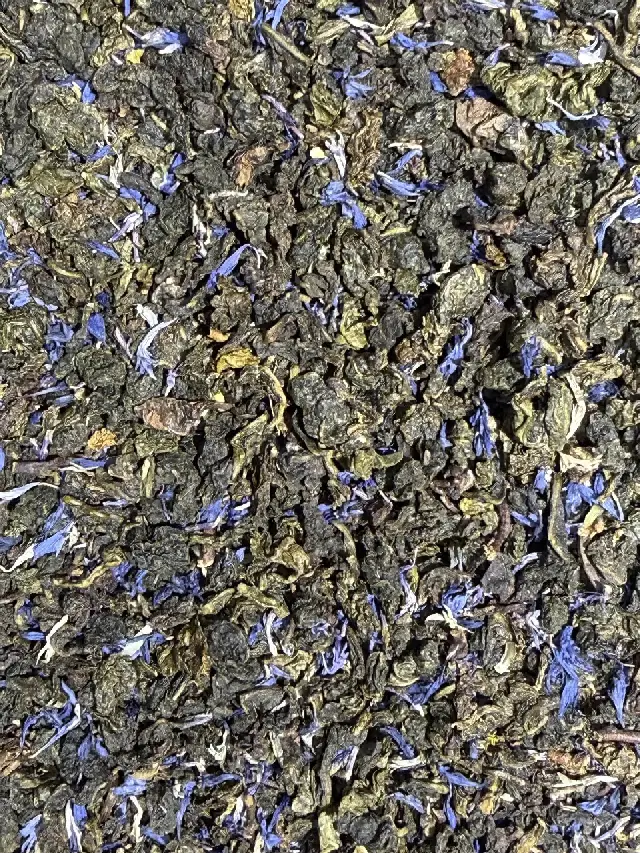
The term "blue tea" comes from the dark blue-green colour taken on by certain leaves rolled into pearls.
Varieties and selection
Formosa (Taiwan) and the Chinese province of Fujian are the historic birthplaces of oolong. A few reference points:
- Oolong de Formose: our Taiwanese reference, balanced between floral freshness and fruity roundness, ideal for discovering the family.
- Lightly oxidised oolongs rolled into pearls, very floral, with notes of lilac and orchid.
- Roasted oolongs, more oxidised, with accents of cooked fruit, toasted hazelnut and caramel.
This is the family of choice for multi-infusion tasting, where the leaf reveals different facets with each steeping.
Preparation
Oolong lends itself to two approaches. Western-style infusion: 90 to 95 °C, 5 to 7 minutes, 2 to 3 g per 200 ml. Gong fu method, more traditional: a generous amount of leaves, water at 90 to 95 °C and short, repeated infusions of 20 to 40 seconds, lengthened with each steeping. A single batch of leaves easily withstands four to six successive infusions.
Oolongs rolled into pearls need time to unfurl: the first infusion may be a little longer, while the leaf opens.
Storage
Like other teas, oolong should be kept in an airtight, opaque container, away from heat and odours. Lightly oxidised oolongs, closer to green tea, are best drunk within the year. Roasted oolongs, more stable, keep happily for two to three years and sometimes gain depth with time.
Understanding oxidation, from green to black
Oolong is the best entry point for grasping the role of oxidation. At 0%, you have green tea, vegetal; at nearly 100%, black tea, robust. In between, oolong explores the whole spectrum. Tasting a floral oolong and a roasted oolong side by side is the most telling way to understand how this single factor transforms the cup.
| Profile | Oxidation | Temperature | Time (Western) |
|---|---|---|---|
| Floral oolong (pearls) | 10 to 30% | 90 °C | 5 to 6 min |
| Balanced Formosa oolong | 30 to 50% | 90-95 °C | 5 to 7 min |
| Roasted oolong | 50 to 70% | 95 °C | 6 to 7 min |
Frequently asked questions
What is oolong tea, or blue tea?
Oolong is a semi-oxidised tea, lying between unoxidised green tea and fully oxidised black tea. Its oxidation level varies from about 10 to 70%, which explains its great diversity of flavours, from delicate floral to roasted woody. It is also called blue tea.
How many times can an oolong tea be infused?
A good oolong easily withstands four to six infusions, especially using the gong fu method with short infusions and a generous amount of leaves. Each steeping reveals new nuances, as the leaf gradually opens.
How do you prepare an oolong de Formose?
With the Western method, allow 90 to 95 °C, 5 to 7 minutes and 2 to 3 g per 200 ml. For gong fu, use more leaves and chain short infusions of 20 to 40 seconds, lengthened with each steeping.
Is oolong tea closer to green tea or black tea?
It depends on its oxidation. A lightly oxidised oolong is closer to green tea, floral and light. A heavily oxidised oolong tends towards black tea, rounder and fruitier. It is precisely this intermediate position that makes it so rich.
To go further