
The Mariage Frères journey · Nature Route · Stopover 3 out of 10
Japan, precision
Japan Green · Japan Roasted Green
First movement
Boarding
The essentials at a glance
Japan Green · Japan Roasted Green
The house selection: Fuji-Yama · Sencha Midori · Hojicha · Kuki-Hojicha
These two families to taste, and a gold stamp to collect by rating your tastings.
Second movement
The port of call lesson
This stopover opens with these two families: you already know how to brew them from the tea school; now meet the house's great names.
Japanese green tea
What sets Japanese green tea apart is steam. Where China sears the leaf in a wok, Japan steams it for a few seconds straight after picking: this gesture fixes the chlorophyll and preserves an intense green, a marine flavour and that savoury roundness known as umami. The method, perfected in Uji in 1738 by Nagatani Sōen, gave rise to sencha, today the everyday tea of all Japan. At its summit reigns gyokuro: its tea bushes are shaded for several weeks before the harvest, which fills the leaf with sweetness and sugar. Fresh grass, seaweed, vegetable broth, hazelnut: Japanese green tea is enjoyed at a low temperature, almost lukewarm, to capture all its finesse.
Japanese roasted green tea
Japan does not cultivate freshness alone: it also knows the art of roasting. By roasting green tea leaves, often late harvests, kukicha stems or bancha, one obtains hojicha, born, so it is said, in Kyoto in the early 20th century. The heat transforms everything: the deep green turns mahogany brown, the bitterness disappears, and the leaf releases warm aromas of roasted hazelnut, caramel, wood and toasted grain. Almost free of bitterness and very low in caffeine, hojicha is drunk at any hour, even in the evening, and even by children. It is Japan's comfort tea, a warm counterpoint to the liveliness of sencha, gentleness after precision.
Third movement
Tasting at home
The Stopover Discovery Trunk 3
Japanese green tea
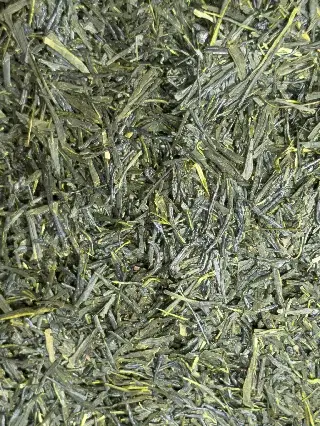
Sencha Midori
A vivid green sencha, grassy and briny, with delicate umami.
Midori means “green” in Japanese, and this sencha lives up to its name: the leaf is a true green, the liquor a soft, clear green. We owe sencha to Nagatani Sōen who, in 1738 in Uji, had the idea of steaming the fresh leaf before rolling it at length. This gesture fixes the chlorophyll and preserves the vegetal freshness. In the cup, cut grass and sea air answer one another, carried by that delicate umami the Japanese prize above all. The very essence of Japanese green tea.
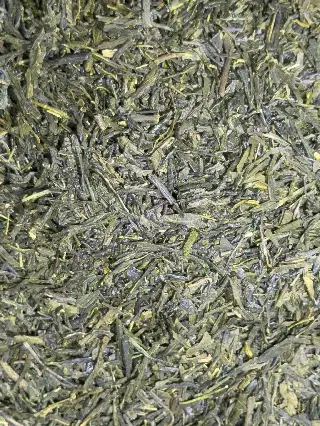
Fuji-Yama
The green of Mount Fuji's slopes: emerald, fruity, with a hint of nashi.
Grown on the slopes of the sacred mountain, Fuji-Yama is the ideal introduction to Japanese green teas. Its tender, bright emerald leaves hint at delicate fruity scents, among them the fragrance of a freshly picked nashi, the Japanese pear. The cup, with jade reflections, unfolds smooth notes of white melon softened by a touch of spring honey. Note: these scents belong to the leaf itself, no flavouring is added. An unflavoured, invigorating green tea of perfect clarity.
Japanese roasted green tea
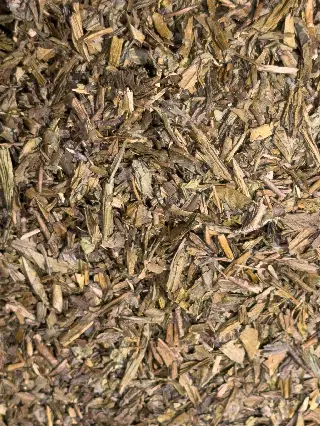
Hojicha
Japan's roasted green tea: mahogany brown, hazelnut and caramel, without bitterness.
Hojicha was born, so it is said, in Kyoto in the early 20th century, when a merchant roasted his leftover leaves. The heat works a metamorphosis: the deep green becomes mahogany brown, the bitterness fades, and scents of roasted hazelnut, caramel and wood rise. Steeping is very brief, one minute is enough, and the water can be hot without risk, unlike Japanese green teas. Mellow, round and low in caffeine, it is drunk at any hour, even in the evening. The warm face of Japan.

Kuki-Hojicha
Roasted stems rather than leaves, extremely mellow, almost caffeine-free.
Kukicha is made not from leaves but from stems and veins, parts of the plant set aside elsewhere. Roasted, they give kuki-hojicha: an amber infusion of remarkable mellowness, with woody, roasted notes. As caffeine is concentrated in the bud and the young leaf, the stem contains very little: it is the lightest tea in all Japan. It is gladly served to children and late in the evening. One minute of steeping is enough to draw out all its fragrance.
The complete stopover trunk 3
These two families · 4 teas in the default format of each product page
€34.50 i.e. ≈ €0.43 the cup of excellence (based on the measure taught, 2 to 3 g of tea per cup)
The stopover protocol
The greens: Fuji-Yama & Sencha Midori
Never boiling water: 80 °C, 4 minutes for Fuji-Yama, 80 °C, 3 minutes for Sencha Midori. Too hot, the water would scorch the umami and bring out bitterness. Look for vegetal freshness and marine sweetness.
The roasted teas: Hojicha & Kuki-Hojicha
Here the water can be very hot: 90 °C, 1 minute for both. Roasting has already consumed the bitterness. Let the roasted hazelnut and caramel rise; both can be drunk in the evening, Kuki-Hojicha even more lightly.
The traveller's ritual
Taste in this order: first Fuji-Yama, fruity and approachable, then Sencha Midori, grassier and more briny; finish with the roasted teas, Hojicha then Kuki-Hojicha. From the liveliest and most marine to the most roasted and round: the whole Japanese palette in four cups.
The Grand Trunk of the Route
All ten stopovers at once: the entire selection Nature delivered in three instalments.
The “Le Voyageur” subscription
One stopover a month for ten months: the trunk, the story and the protocol arrive at your door.
Subscribe to the journey