
Le Cercle de l'Ombelle · Moon 1 out of 12
January — The Southern Cup
Winter · 14 references pickeds this moon · the great skein of rooibos
First movement
The harvest
The essentials at a glance
The Southern Cup · Winter
14 references pickeds this moon, of which 0 contain caffeine.
The great skein of rooibos.
The first moon of the year does not belong to our countryside, but to the foothills of the Cederberg, in South Africa, where January is the heart of the southern summer. While our gardens sleep beneath the frost, the red shrub is cut by sickle under a blazing sun. Rooibos grows nowhere else on Earth: not in China, not in India, not in any other African country, only on this sandstone massif, between four hundred and nine hundred metres above sea level, where the dry air and rainy winters suit it. Every attempt to acclimatise it elsewhere has failed. This is the herbalist's great paradox: the hottest harvest of the southern hemisphere fills our winter cups. January therefore opens the Circle with a journey, that of a plant which crosses the inverted seasons to come and warm our own, red needle after red needle.
The first full moon of the year rides highest in the sky: it peaks where the June sun once passed. Beneath it, our gardens sleep, and life has withdrawn into seed and root. But in the Cederberg it is summer: rooibos harvesters, true to tradition, like to cut under a waning moon, when the sap descends; the needles, they say, dry better and keep longer.
Second movement
The moon lesson
This moon harvests 3 plants ; here are their botanical profiles and their rituals.
Rooibos
Aspalathus linearis · Fabaceae
The only plant of these two moons grows nowhere but in the Cederberg, in South Africa, on a sandstone massif between four hundred and nine hundred metres above sea level. It is a shrub of the Fabaceae family, a cousin of peas and lentils, with fine green needles. Cut in the height of the southern summer, it is chopped, bruised, then left to oxidise in the full sun: this slow fermentation turns its needles a coppery red and develops its honeyed taste. Dried immediately without oxidation, the same shrub instead gives a green rooibos, pale and grassy. A single step, exposure to the air, therefore separates two drinks of opposite appearance and flavour; the whole making of rooibos lies in this choice.
Green rooibos
Aspalathus linearis · Fabaceae
It is the same shrub, the same mountain and the same southern summer cutting, but an entirely different process. Where red rooibos is chopped, bruised and then left to oxidise for several hours in the full sun, green rooibos is dried immediately after harvest, never going through this stage. Its needles therefore keep their original colour, between pale green and straw, and the cup stays clear, almost golden. The profile changes completely: where the red gives honey and wood, the green remains grassy, vegetal, livelier and lighter on the palate. A single step, exposure to the air, separates these two drinks that nothing, at first sight, seems able to bring together. Proof that the making matters as much as the plant.
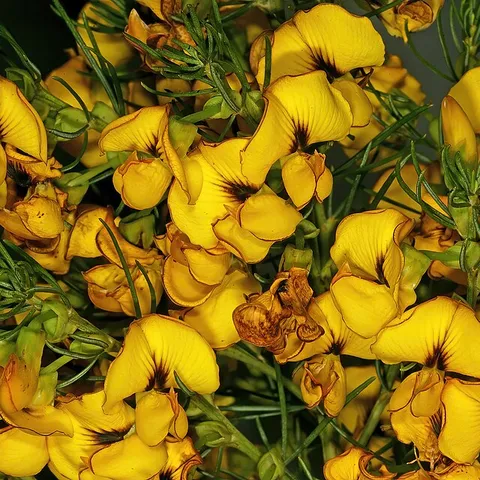
Honeybush
Cyclopia intermedia · Fabaceae
Honeybush is rooibos's cousin: another shrub of the Cape mountains, from the same Fabaceae family, whose bright yellow flowers smell of honey, and it is they that give it its name. Like rooibos, it is cut during the southern summer, then oxidises and dries in the sun to take on its amber colour. Rounder and sweeter than its cousin, with notes of honey and dried apricot, it slips into several blends of this moon: look for it in the Évasion Exotique. Long gathered in the wild, it is gradually being cultivated to preserve the resource.
Photo: Cyclopia genistoides · SAplants, CC BY-SA 4.0, Wikimedia Commons
Third movement
Tasting at home
The Moon Basket of January
Rooibos
Rooibos de Noël Pomme Cannelle Bio
100°C · 7-10 min · 15-20 g/L
This second organic Christmas rooibos plays the gourmand card: to the red needle are added roasted buckwheat, crushed cocoa beans and cinnamon sticks under a natural apple flavouring. The dry blend, copper and brown, smells of biscuits fresh from the oven; the mahogany liquor unfolds an unusual toasted roundness, the roasted buckwheat recalling the Breton galette, the cocoa its depth, the apple-cinnamon its festive refrain. Naturally caffeine-free, it is December teatime in a cup, biscuit included.
Rooibos Canneberge Gingembre Bio
100°C · 7-10 min · 15-20 g/L
Rooibos and lemongrass welcome ginger and cranberry, as berries and natural flavouring, in this organic red fruit blend with a tangy character. The dry blend, copper and garnet, smells of fresh berries and zest; the red amber liquor nicely contrasts the malty roundness of rooibos with the clean tang of cranberry, the ginger warming the background and the lemongrass tracing its clarity. Naturally caffeine-free, lively and refined, it is the red fruit rooibos for palates that do not like sweetness.
Green rooibos
Rooibos Vert Verger d'Ananas Bio
100°C · 7-10 min · 15-20 g/L
A base of green rooibos, the unoxidised needle, more vegetal and fresher than red, apple in two forms, carrot and natural pineapple flavourings: this organic exotic blend is all about clarity. The dry blend, green-yellow, smells of a tropical orchard; the pale golden liquor unfolds the grassy freshness of green rooibos, the juicy flesh of pineapple and the tender sweetness of apple and carrot, with no harsh acidity. Naturally caffeine-free, light and luminous, it is a daytime rooibos that excels iced.
Rooibos Vert Vanille Orange Sanguine Bio
100°C · 7-10 min · 15-20 g/L
A base of unoxidised green rooibos, fennel, orange peel, verbena in two forms and vanilla extract: this organic blend is all about dressed-up freshness. The dry blend, green and saffron, smells of vanilla-scented zest; the pale golden liquor combines the vegetal liveliness of green rooibos, blood orange in rounded zest, the floral lemon of verbena and a discreet veil of vanilla, with fennel binding it all with a hint of anise. Naturally caffeine-free, delicate and soothing on the palate, it is the green rooibos for elegant evenings.
Honeybush & co.
Rooibos Évasion Exotique Bio
100°C · 7-10 min · 15-20 g/L
Rooibos and honeybush travel together in this organic blend: the two shrubs of the Cape, united under candied orange, sweet banana and apricot. The dry blend, copper flecked with peel, smells of a basket of ripe fruit; the amber liquor marries the malty roundness of rooibos with the honey of honeybush, the orange leading the exotic dance. Naturally caffeine-free, it is an all-day escape, heading south.
Rooibos Soleil Vanille Exotique Bio
100°C · 7-10 min · 15-20 g/L
This organic rooibos puts sunshine in the cup: mango, papaya and banana on the red needle, under a veil of vanilla and rose petals. The dry blend, flower-strewn copper, smells of a tropical market; the amber liquor unfolds the rounded woodiness of rooibos, juicy mango, sweet orange, with vanilla rounding off the finish. Naturally caffeine-free, it can be drunk from morning to evening, and iced, it becomes a ray of summer.
A source of pleasure, not a medicine. If you are pregnant, breastfeeding, undergoing medical treatment or have a medical condition, seek the advice of a healthcare professional.
The moon's ephemeral
A limited series, available for the duration of the harvest of january. When the moon passes, the ephemeral goes with it.
The Twelve Moons subscription
Every moon, twelve times a year, the harvest basket arrives at your door: 6 references, two per type, making 72 references over the year, the story of the picking and the ritual.
Subscribe to the Twelve MoonsFourth movement
All the moon harvests
The other references picked this moon, to record in your tasting notebook.
Infusion Maison du Verger Bio
Rooibos Baies Noires & Cassis Bio
Rooibos Fruits des Bois & Sarrasin Bio
Rooibos Été Mangue Orange Bio
Rooibos Gingembre Citron Vif Bio
Rooibos Orange Mandarine Sauvage Bio
Rooibos Orange Ensoleillée Bio
Rooibos du Cap Citron Passion Bio